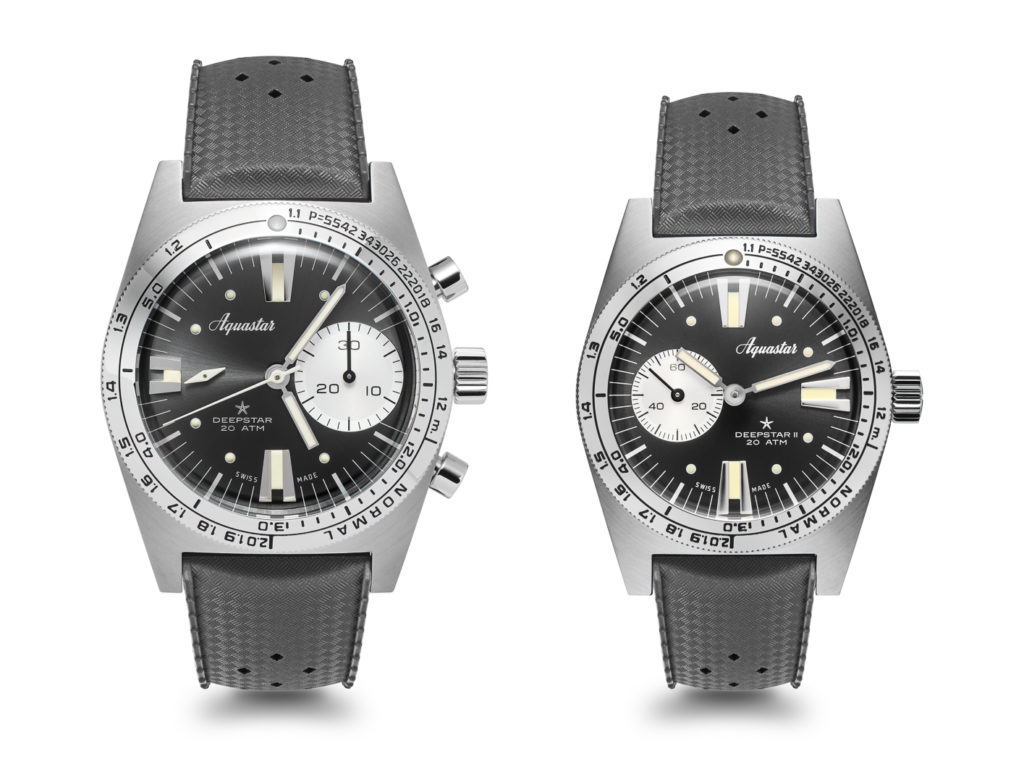
The patent that defined the modern Swiss dive watch.
Filed 15 May 1964 by Marc Jasinski for Aquastar S.A. of Geneva (CH 436 140), the Deepstar bezel is the world's first multiple-dive no-decompression chronograph mechanism. It carries two scales, an inner 60-minute elapsed-time scale and an outer no-decompression scale calibrated to the French Navy tables of the period, and lets a diver plan a first dive, time the surface interval, and execute a repetitive second dive directly off the wrist, without a slide rule and without a separate table.
Sixty-two years later the geometry is unchanged. Every modern Aquastar Deepstar carries the bezel pattern that came off the original 1962 blueprints.
How it works: a worked example.
To understand the bezel, it helps to walk through a worked example using the same 1960s French Navy decompression table the bezel was calibrated against. The scenario below is the standard repetitive-dive plan a Marine Nationale combat diver would have read at the time.
First dive.
Pick a hypothetical depth for a first dive and find the corresponding maximum bottom time on the table. A dive to 39 metres (approximately 130 ft) for 25 minutes. Where depth and time intersect, the table gives two numbers. The primary number is the mandatory decompression time for the dive in minutes. The second number is the partial pressure of absorbed nitrogen in the body, known as "Coefficient C." This Coefficient will be used later during the surface interval, before the repetitive dive.
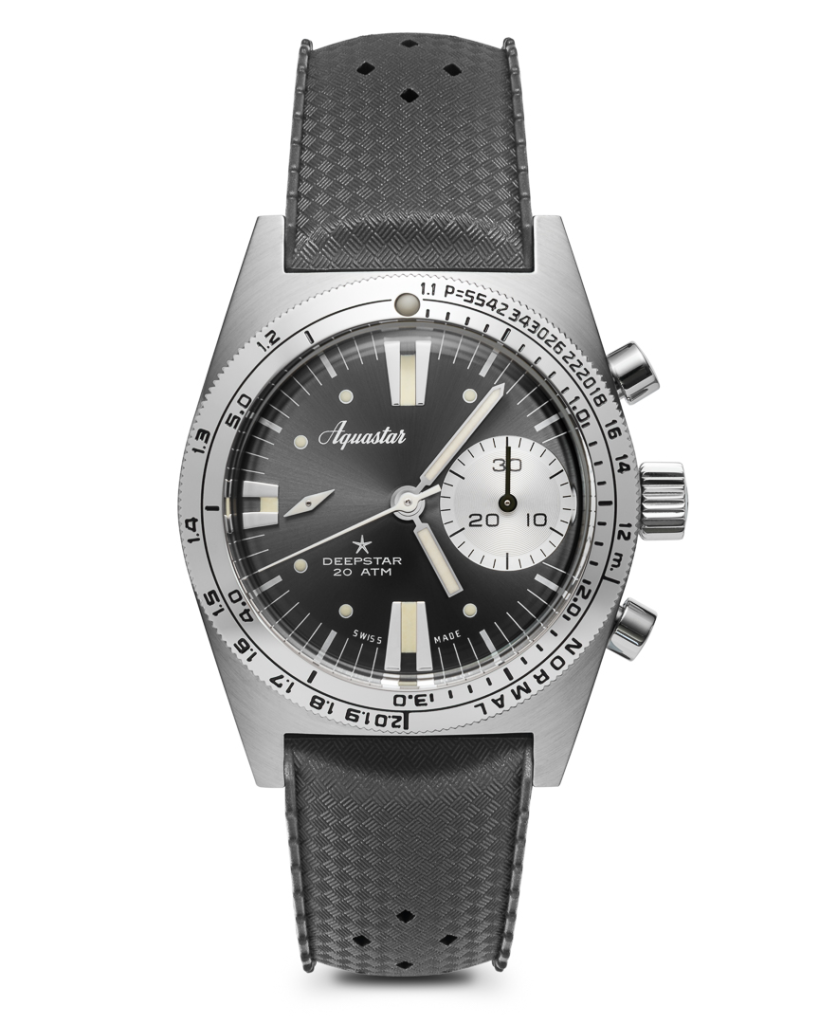
Now look at the Aquastar bezel itself. It has two scales, an inner scale and an outer scale. The inner scale is the traditional 60-minute elapsed-time scale found on every other dive watch. The outer scale is the key to calculating repetitive dives.
Before jumping in, the diver aligns the zero marker, the lumed pip on the bezel, to the minute hand, the standard procedure for measuring elapsed dive time. During the dive, the minute hand advances on the inner scale, showing how many minutes have passed at 39 metres. When the hand reaches the 25-minute mark, previously planned, the bottom phase is over and it's time to ascend to the decompression stop. The decompression stop should be made for 15 minutes, after which the ascent to the surface should be completed.
Surface interval.
Once at the surface, the outer scale is used to factor nitrogen off-gassing in preparation for the second dive. Here's where the previously determined Coefficient C, say 1.6, is used. The 1.6 value on the outer scale of the bezel is now aligned with the hour hand. As the hour hand advances, the bezel shows the decreasing values of absorbed nitrogen, 1.5, 1.4, 1.3, 1.2. If the value has not decreased below 1.4, the concentration of nitrogen in the body is still too high, and a second dive cannot be made.
Second dive.
The second dive is planned for a shallower depth, say 30 metres. The second dive should always be shallower than the first.
Scenario A. If we look at the outer "P=55-12 metres" scale and find the 30 (the planned dive depth), the 6-minute mark on the inner scale aligns with the 30 m mark on the outer bezel. This 6 minutes is the time "handicap", the penalty time to subtract from the second dive. When enough surface time has passed and the hour hand passes from the original Coefficient C of 1.6 down to a new Coefficient C of 1.1, that full 6-minute penalty applies. Going back to the table, the 30-metre depth with a planned 30-minute dive becomes 24 minutes of actual bottom time. The decompression time stays as the table specifies, a 3-minute mandatory decompression, and according to the table the new Coefficient C after this second dive is 1.5.
Scenario B. If the surface interval was shorter and the hour hand has reached only the 1.3 range, the number on the right of that range, "3" in this example, is used as a multiplication factor on the 6-minute penalty: 6 × 3 = 18 minutes are subtracted from the 30-minute planned dive. The second dive shrinks to 12 minutes. At the 1.2 range, the multiplier is 2: 12 minutes are subtracted, leaving an actual dive of 18 minutes.
If the surface interval passes beyond the 1.1 range and into the "Normal" section of the scale, all nitrogen is considered to have off-gassed from the body. At that point a "second" dive can be planned as a fresh first dive, with no handicap.
Historical context.
The Deepstar bezel was developed and patented on the basis of the scientific research conducted in the early 1960s on gas saturation in the human body during diving. The worked example above is provided for historical verification of the bezel's design intent and is not a current diving recommendation. The 1960s French Navy decompression tables have been replaced or updated since; modern diving practice relies on personal dive computers and the current decompression algorithms maintained by the standards bodies. The bezel on the watch remains, and reads, exactly as it was designed in 1964.
Where to go next.
See the Deepstar collection: every modern Deepstar carries this bezel.
Read about the column-wheel calibre: the chronograph mechanism that sits below the bezel.
Read the ten patents: the full archive including CH 436 140 (Jasinski, 1964).